BPM Platforms: Evolution or Archaism?
I’m currently working on my dissertation about implementing modern methods of service delivery process management in applications. At some point, I asked myself a question that I’m sure many architects and technical leaders share: how relevant are BPM platforms in 2025, really?
Is using BPM engines for complex processes a step towards the evolution of code, operations, and maintenance? Or is it a bottleneck and an archaism that should be buried?
The answer turned out to be less straightforward than I expected. Camunda’s fresh “State of Process Orchestration & Automation 2025” report gave me plenty of food for thought. Here are the key findings and my takeaways.

About the Report
Camunda commissioned Coleman Parkes to survey 800 respondents - IT directors, business decision makers, and enterprise software architects at organizations with 1,000+ employees (350 US, 150 UK, 150 Germany, 150 France). The survey was conducted in September–October 2024, covering the current state of process automation, the impact of AI, and challenges of managing process complexity.
Yes, Camunda has skin in the game. But the numbers are interesting in their own right - they describe problems I see in my own practice every day.
The Rise of Uncontrolled Complexity
The first thing that stands out: organizations average around 50 components and integration endpoints in their processes. This number has grown by 19% over the past five years.
What makes up this zoo:
Meanwhile, 78% say complex workflow patterns and long-running processes are increasing the difficulty of automation. And 85% confirm: when multiple automated tasks are combined, managing the overall end-to-end process becomes significantly harder.
What drives this complexity:
And the key number: 86% report increased regulatory requirements, adding even more pressure.
”Automation Armageddon” - Not Clickbait
Camunda coined the term “Automation Armageddon,” and surprisingly, respondents confirmed it:
- 82% are concerned that a lack of control will lead to digital chaos
- 77% say that a lack of control has resulted in core business processes no longer working
- 82% report increased business risk related to compliance
- 69% admit it’s increasingly difficult to effectively analyze and optimize processes
Most telling: 82% say if these risks are left unchecked, it could lead to what they describe as “Automation Armageddon” - where automation errors snowball into catastrophic outcomes.
Automation without control turns into accelerated chaos. I’ve seen it more than once: an error in one ESB route cascades through the entire chain, and on-call teams spend nights cleaning up the mess.
AI - The Double-Edged Sword
A dedicated chapter covers AI, and the numbers are particularly interesting for those in architecture:
Now:
- 85% face challenges scaling and operationalizing AI across their organization
Future:
- 84% are looking to add more AI capabilities over the next three years
- Most respondents see potential in using AI to analyze and optimize processes
Compliance:
- 84% admit that a lack of transparency into how AI is used within business processes is leading to regulatory compliance problems
The report emphasizes: AI needs to be orchestrated like any other endpoint within business processes.
AI isn’t a magic pill you can drop into a process and hope for the best. Without orchestration, AI becomes yet another silo that increases chaos.
The Real State of Automation
Now for the sobering numbers:
Positive:
- 93% have a center of excellence for process automation
- 87% report business growth thanks to automation over the past year
Concerning:
- On average, only 46% of organizational processes are automated - less than half
- 83% plan to increase automation budgets by 10%+, yet 72% say existing automation cannot keep pace with the rate of change
- 82% say their process automation is beginning to become outdated without orchestration
Automating individual areas is easy. Linking them into a working end-to-end process that also changes every quarter - that’s where the pain begins.
Composable Architecture vs. Monoliths
The report confirms a trend I observe in my practice:
- 94% say composable architecture that allows flexibility in integrating best-of-breed solutions is important
- 83% say large monolithic enterprise applications (ERP) that dictate business process design need to become a thing of the past, though many face challenges adapting to this approach
But transitioning to composable architecture faces two main barriers:
- 55% - transitioning from deeply entrenched legacy systems or monolithic automation platforms
- 51% - internal resistance to adopting new technologies
The legacy problem in detail:
- 81% say business processes locked in “black box” legacy applications are holding them back from efficient end-to-end automation
- 85% admit legacy systems and a lack of IT agility mean they can’t always meet business demands
If BPM Is Dying - Why Are There So Many?
A fair question arises. If 83% say monolithic systems should become a thing of the past, then why is the BPM/BOAT (Business Orchestration and Automation Technologies) market only growing?
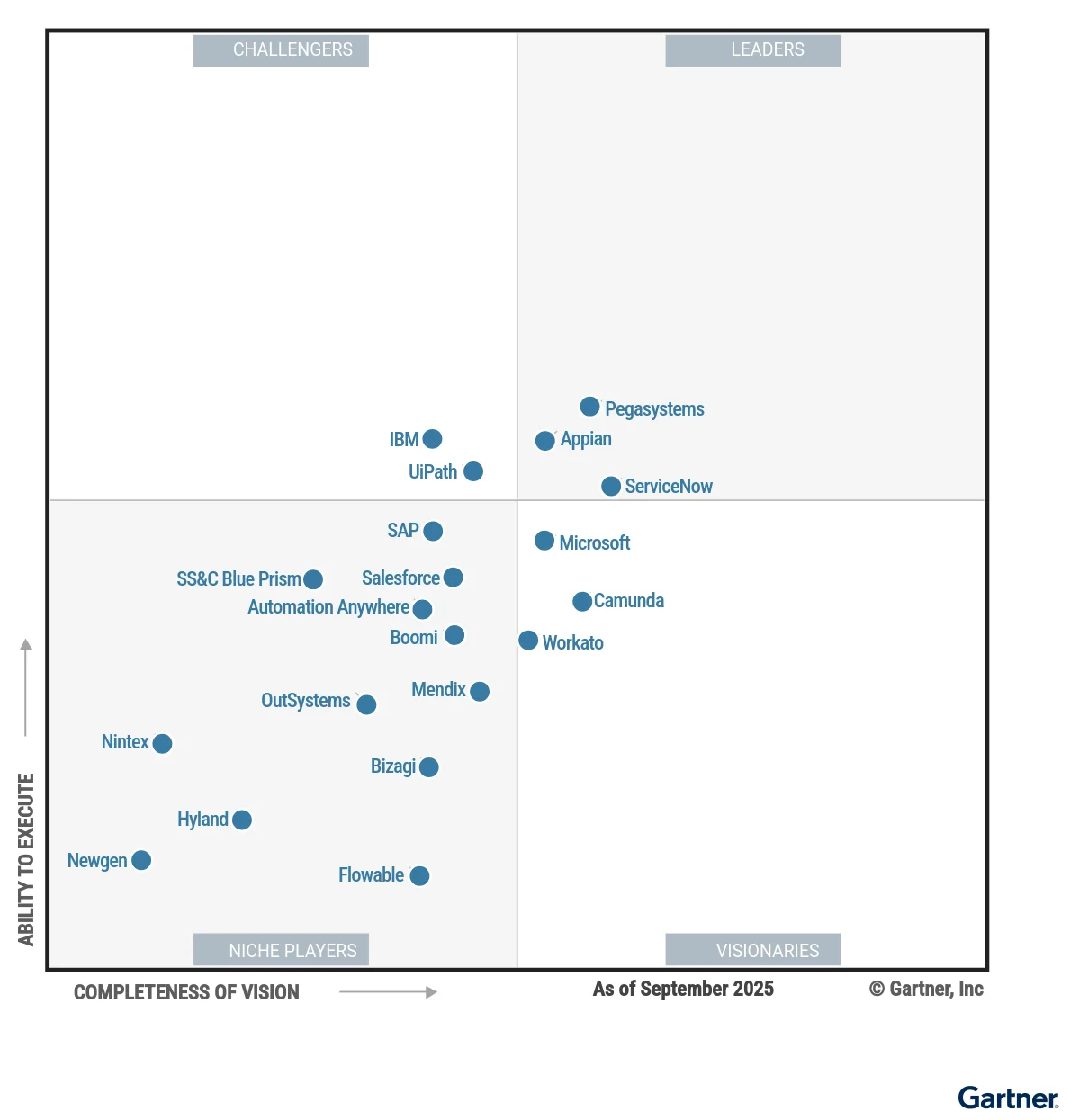
Just look at the Gartner Magic Quadrant 2024 for BOAT - there are dozens of vendors, and the Leaders quadrant is densely populated. IBM, Microsoft, Camunda, SAP, Appian, Pega - all actively investing and expanding their products.
The paradox has a simple explanation: it’s not the need for process orchestration that’s dying - it’s a specific form of its implementation. The classic BPM monolith that tried to be a “platform for everything” - with its own portal, its own database, its own scripting language - yes, that’s going away. But more flexible forms are taking its place:
- Cloud-native engines (Camunda 8, Temporal) - embed into existing infrastructure
- Low-code platforms (Appian, Pega) - shifted focus to citizen development
- Hyperautomation (Microsoft Power Automate, ServiceNow) - combine RPA, AI, and orchestration into a unified ecosystem
The market isn’t shrinking - it’s transforming. That’s precisely why Gartner renamed the category in 2023 from “iBPMS” to “BOAT” - Business Orchestration and Automation Technologies. The name itself signals a paradigm shift: from management to orchestration, from pure BPM to a hybrid of automation and AI.
The takeaway: if you look at this quadrant and think “BPM is alive,” you’re right. But if you think you can buy one platform and solve all problems - the Camunda report data says otherwise. 82% of companies with automation already admit it’s becoming outdated. The tool should be part of the architecture, not its center.
Why Orchestration Matters (And Where BPM Fits)
The most telling numbers are about the value of orchestration:
- 89% of organizations are already practicing process orchestration
- 72% believe orchestration plays an important role in digital transformation
- 86% say hyperautomation is impossible without orchestration
- 81% believe without orchestration, the autonomous enterprise will be a pipe dream
But orchestration maturity varies greatly:
The benefits are concrete: improved customer experience (55%), process standardization (44%), faster decision making (42%), better integration and reuse (42%), increased employee satisfaction (41%).
The Business-IT Divide
The report highlights a painful gap familiar to anyone who’s worked in large organizations:
Each side has its grievances. Business says: “IT often says no, citing technical limitations” (39%). IT responds: “Business doesn’t understand the amount of work created when they change processes” (44%).
The report’s proposed solution: open standards (BPMN, DMN) that allow both sides to visualize and model processes using a shared language. And open architectures that give IT teams the flexibility to integrate different tools for specific business requirements.
BPM + AI Agents: The Next Mutation
While some are burying BPM, Camunda is going further and proposing to build AI agents on top of BPMN. The idea: a BPMN diagram becomes not just a process visualization, but executable reasoning logic for an agent - with planning, reflection, and decision-making loops.
What this provides in practice:
- State management - the agent maintains “short-term memory” between reasoning steps and “long-term memory” at the process level (durable state that survives days and weeks)
- Human-in-the-loop - BPMN explicitly defines points where human approval is needed and points where the agent acts autonomously
- Observability - full auditability and tracing of every agent step, critical for compliance
- Multi-agent patterns - coordination of multiple agents via message correlation and protocols like MCP (Model Context Protocol) and A2A
LLM connectors (OpenAI, Gemini, Claude) come out of the box. In essence, the process orchestrator transforms into an AI agent orchestrator.
Honestly, I’m not yet convinced that a BPMN diagram as the “agent brain” won’t turn out to be overengineering for 90% of cases. But the idea is interesting: if the report explicitly states AI needs to be orchestrated like any other endpoint, Camunda at least offers a concrete answer - not just slides with buzzwords.
n8n and the Democratization of Orchestration
Worth mentioning separately is n8n - an open-source workflow automation platform that has gained serious momentum in recent years. While Camunda, Pega, and Appian play in the enterprise segment, n8n has carved a niche that could be called “orchestration for everyone else.”
Why this matters in our discussion:
- Self-hosted and open-source - no vendor lock-in, full data control
- 400+ integrations - from Slack and Google Sheets to OpenAI and custom APIs
- AI-first approach - built-in nodes for working with LLMs, vector databases, AI agents
- Low barrier to entry - visual editor accessible to non-developers
n8n doesn’t replace an enterprise BPMN engine for complex long-running processes with human-in-the-loop. But for operational workflow automation, AI service integration, and rapid prototyping - it’s exactly the kind of composable alternative that 94% of the report’s respondents advocate for.
The combination of “lightweight BPMN engine for core processes + n8n for operational automation + AI agents” outlines an architecture that genuinely addresses the challenges described in the Camunda report.
So - BPM: Evolution or Archaism?
Back to my original question. After analyzing these numbers, my answer is:
Monolithic enterprise systems that dictate process design - yes, their time is up. 83% of respondents believe large monolithic applications like ERP systems that impose their business process model should become a thing of the past. Not “BPM” specifically - but the entire paradigm of “one platform owns your processes.” Vendor lock-in, proprietary languages, black boxes - it’s a dead end regardless of whether the label says BPM, ERP, or iPaaS.
But the concept of process orchestration itself is undeniably an evolution. When you have 50 integration endpoints, AI services, RPA bots, microservices, and legacy systems, something needs to coordinate the entire zoo. And code alone - without visualization, without standards, without observability - can’t handle it.
Here’s how I see the future:
- Orchestration as code - BPMN models that live in git, go through code review, and deploy via CI/CD. Not drag-and-drop in a proprietary GUI, but models as development artifacts
- Composable architecture - lightweight engines (Camunda 8, Temporal, Zeebe) that integrate into microservice architectures rather than imposing their own
- AI as a managed endpoint - AI services orchestrated alongside any other integration point, with clear control and audit trails
- Shared language - BPMN not as formality, but as a communication tool between business and IT, bridging the gap that 62% of respondents describe
Maybe in a couple of years I’ll reread this and think I was naive. Maybe Temporal will eat Camunda, and n8n will become the new SharePoint. But right now I see one thing clearly: a BPM engine is neither a silver bullet nor an archaism. The question isn’t about the tool - it’s about who owns whom. If the platform owns your processes - you’re trapped. If the processes are yours and the platform is a replaceable component - then there’s a chance.
Source: Camunda - State of Process Orchestration & Automation 2025 (Coleman Parkes Research survey, 800 respondents, September–October 2024)